Humans Pick, or Machines Learn
Every program is a box with knobs. Until now, WE set them. What if the computer could?
What you'll learn
- Programming vs Learning
- Rules vs Data
In this video
Quick recap. Every function is just a little box with knobs on top. You feed it something, it spits something back. And those knobs? They're what makes the box do its job.
And a whole program? It's a chain of those boxes, lined up in order. Like a recipe — first do this, then this, then this. Every app on your phone is built like that.
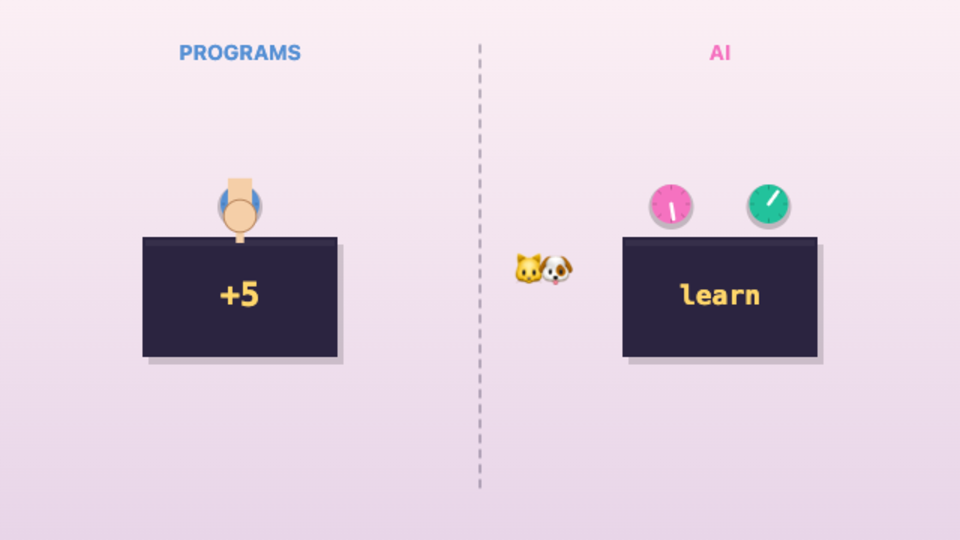
Now here's something you might not have noticed. See the hand? For every program ever written, a person had to reach in and set those knobs themselves. Every single one. That's been the deal forever.
And honestly? That works just fine when the rule is obvious. Want to add five to a number? You set the knob to five. Boom. Three becomes eight, ten becomes fifteen. Easy.
But now try this one. Look at a picture and say if there's a cat in it. Sounds simple, right? You can do it in half a second. But pause and ask yourself — what's the rule? What exactly makes something a cat?
Watch — every rule we try, it falls apart. Four legs? So does a dog. Pointy ears? Foxes too. Whiskers, meows, fits in a box? Some cats break every single one. There's just no clean rule that works.
Here's a completely different way. Forget writing rules. Just hand the computer a giant pile of labeled examples — cat, cat, cat, dog, dog, dog — and let IT spot the pattern. The programmer stops being a rule-writer and starts being a teacher.
And here's the magic part. No hand. No human reaching in. The computer wiggles its own knobs, tries stuff, and slowly tunes itself based on the examples. [pause:400] That's what we mean by learning.
Okay, your turn. Hit the button to feed the learner one example at a time. Watch what the knobs do — they jiggle around at first, then start to settle. That's it learning, right in front of you.
So look at the two sides. On the left, the old way — a person picks the knob. On the right, the new way — examples flow in, and the computer picks the knob. That flip, right there, is what AI actually is.
Try this with me. I'll show you a task, and you decide — would you just program it with a clear rule? Or is it the kind of thing where the computer needs to learn from examples? Don't worry about being wrong, just give it a shot.
And once you see this trick, you'll spot it everywhere. Face unlock on a phone, asking Siri or Alexa for stuff, ChatGPT, even searching your photos for the beach. All the same recipe — pile of examples in, smart-looking rules out.
Let's lock it in. Programs — a human writes the rules. AI — show examples, and the computer works the rules out for itself. We use AI when rules are too messy to write by hand. And the stuff it learns? It all lives in the knobs.
Now here's the question. AI sounds cool, but it's not always the right tool. Sometimes a plain old rule beats it cold. So how do you tell which path to pick? That's exactly where we're going next.
Topics
Ready to try it yourself?
Humans Pick, or Machines Learn is a hands-on interactive video — watch it, then play with the idea live in your browser. Free, no sign-up.
Open in Kekula →