The Two-Symbol Trick
Why does a computer only know 0s and 1s — and how is that enough for everything?
What you'll learn
- Binary
- Bits & Bytes
- Place Value
In this video
Okay, ready for something kinda wild? Computers, every single one of them, only understand two things. Not a hundred. Not even ten. Just two. And from those two things, they make games, songs, photos, everything. Let's see how.
Picture a light bulb. Look — it's either on, or it's off. There's no in-between. That's the entire alphabet a computer uses. Two states. On, off. That's it. Pretty bare-bones, right?
Now let's give them names. Off, we call zero. On, we call one. Easy. And inside your phone or laptop, there are billions of tiny switches just like these, flipping on and off. Honestly, that's all the hardware can do.
But hold on. If a computer only has zeros and ones, how on earth does it write the number five? Or a hundred? Or a million? Seems impossible, right? Well, there's a clever little trick. Watch this.
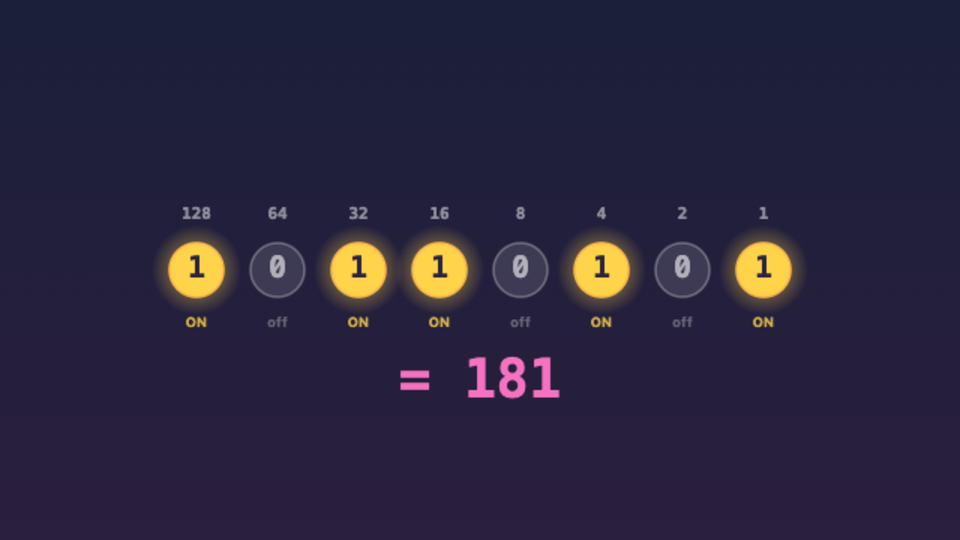
Here's the trick. Every switch is worth a number — one, two, four, eight, and so on. If a switch is on, you grab its number. If it's off, you skip it. Then you add up what's left. See? Four plus one. That's how you spell five in computer.
Let's count up together. Zero, one, two, three. Look — see how the switches flip on and off in a pattern? Every time we add one, the switches do their little dance. Same trick, just on repeat.
Okay, your turn. Drag the slider and watch what happens. The switches figure out which ones to flip on so they add up to your number. Try a few. See if you can spot the pattern.
Quick vocab break. One little switch like this is called a bit. Stick eight of them in a row and you get a byte. And if you flip every single bit on, eight bits can count all the way up to 255. That's a lot from just eight little switches.
Now you're the computer. Tap the switches to flip them on or off, and build any number you want — from zero all the way to 255. Try making your age. Or 100. Or go wild and make 255. Have fun.
But here's the cool part — bytes don't just have to mean numbers. The number 65 can stand for the letter A. Another number can be a tiny piece of a sound. Another can be how bright a colour is. Same bits, different meanings.
Remember pixels from the pictures video? Every single pixel on your screen is just three bytes. One for red, one for green, one for blue. Mix those three numbers and bam — you get any colour. This little orange square? Just three numbers.
Now zoom out. Your phone, right now in your pocket, has billions of these tiny switches. Billions. All just clicking on and off, super fast. Every video, every game, every text — it's all just counting with zeros and ones.
Let's catch our breath. Two symbols, zero and one. Each switch worth a different value. Eight bits make a byte. And from that, you get every letter, every colour, every sound. Tiny alphabet. Huge results.
But wait — where do all these zeros and ones actually live? Like, where does the computer keep them? That's a whole thing called memory, and it's the next stop on our adventure. See you there.
Topics
Ready to try it yourself?
The Two-Symbol Trick is a hands-on interactive video — watch it, then play with the idea live in your browser. Free, no sign-up.
Open in Kekula →