The Internet Is Many Networks
What is 'the internet', really? Billions of connections, routing packets around the globe.
What you'll learn
- Internet
- Routing
- IP Addresses
- DNS
In this video
Last time, two phones traded a tiny message. Cool. But take a look at this. Every blinking dot here is a real device, somewhere on Earth, talking right now. And that's just a tiny sample of what's actually happening.
Let's start tiny. Watch — see that little box in the middle? That's your router. It's the friend in the group chat that passes messages around. Your phone, the TV, a laptop — they all hook into it. Together, they're a network. Your home network.
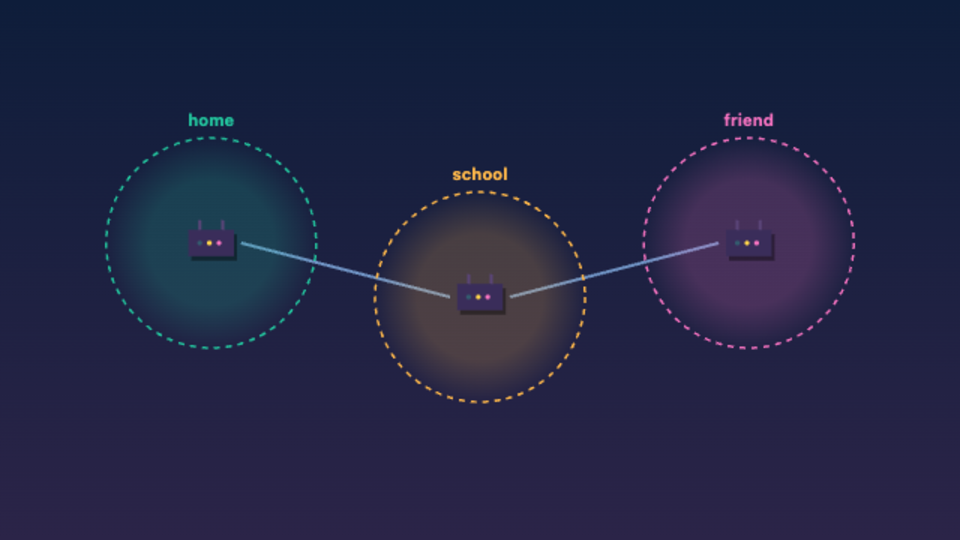
Now zoom out a bit. Your neighbour next door? They've got their own little network too. So does your school. So does the cafe down the street. Each one is its own bubble — separate, doing its own thing.
But here's the magic. Watch those lines pop in. Networks can hook into each other through bigger routers — kind of like roads connecting neighborhoods. And see that little glowing dot? That's a packet, hopping from one network, through the next, to the one after. That's how it travels.
Now keep pulling back. And back. And back. Every dot you see is another network, somewhere on the planet — and they're all linked up. [pause:400] That, right there, is the internet. Not one giant thing. Just millions of small things, all holding hands.
Okay, your turn to play. Pick a device to send from, and one to send to — maybe your phone to your friend's laptop. Watch the packet take the trip. Notice how it always stops at each router on the way? That's the route it's hopping.
But wait — how does the packet even know WHERE to go? Same way the mail finds your house. Every device gets its own address. We call it an IP address. Look — that's what one looks like. Just numbers with dots.
Honestly though — nobody wants to memorize a string of numbers, right? You type kekula dot ai. Easy. But the computers only get those number addresses. So somebody, somewhere, has to do the translating. Who?
Meet DNS. Big fancy name, simple job. Watch — your computer sends the name to DNS. DNS looks it up, like flipping through a phone book. Then it sends back the real address. Boom — now your packet knows where to go.
Try it yourself. Tap any of those names and watch what address pops out. Every name on the internet has a real number address hiding behind it. DNS is the helper that knows them all.
All of that is happening, like, RIGHT now. While you're watching this, billions of packets are zipping around. Millions of names are being looked up. Every single second. The whole thing never sleeps.
Quick recap. Devices form networks. Networks connect through routers. Every device has its own IP address. DNS turns names into those addresses. And packets just keep hopping till they arrive. That's it. That's the whole internet.
So you know how the packets get there. But here's the next puzzle. When you open a website — what are those packets actually carrying? What IS a webpage, really? That's where we're headed next.
Topics
Ready to try it yourself?
The Internet Is Many Networks is a hands-on interactive video — watch it, then play with the idea live in your browser. Free, no sign-up.
Open in Kekula →