Is the AI Sure?
AI always guesses. It shows confidence, not truth. And sometimes confidently wrong — hallucinations and all.
What you'll learn
- Probability
- Confidence
- Hallucinations
In this video
Here's something most people never think about. When an AI gives you an answer, it sounds super confident, right? But behind the scenes, it's making a guess. So today, let's peek behind the curtain and find out how sure the AI really is.
Look at this card. The AI thinks it's a cat, and right next to it is a number. That number is its confidence. Eighty-seven percent means the AI is saying, hey, I'm pretty sure, but not totally. It always works this way. Always a percentage.
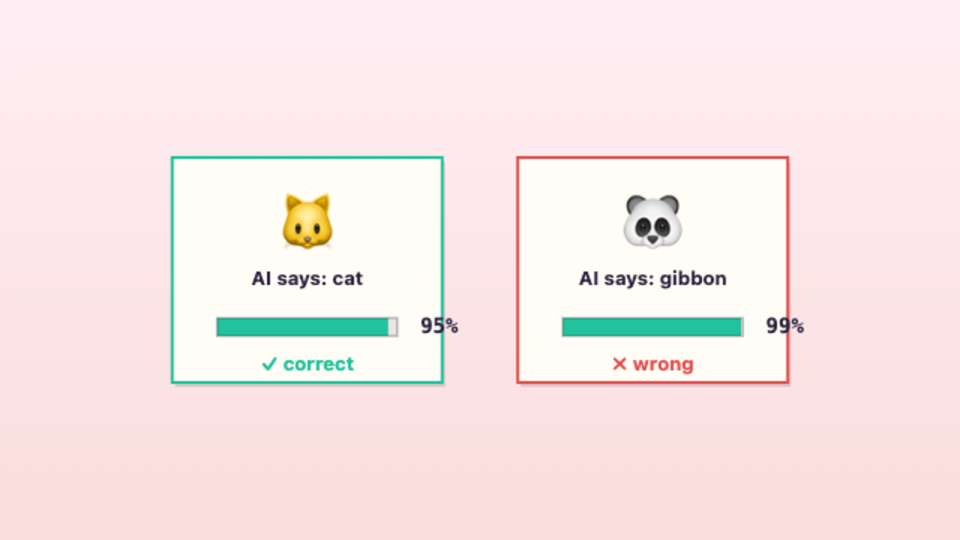
Watch the difference. On the left, ninety-five percent — that's the AI saying "I'd bet on this." On the right, fifty-five percent — basically a coin flip. Same answer, totally different trust level. The number tells you how seriously to take it.
Okay, your call now. Look at the picture, look at the percentage, and decide — would you just go with it, or double-check first? Try a few. There's no perfect answer. You're learning to read the AI's signals.
That's a panda. The AI says ninety-nine percent gibbon. A gibbon is a kind of monkey. [pause:400] The AI isn't a little wrong — it's swinging-from-trees wrong. And it has zero clue. This actually happens to real AI all the time.
Here's the big idea — confidence is not the same as correctness. The AI saw patterns in its training pictures and matched them. It never checked if it was actually right. Loud and sure does not mean right. Remember that one.
Watch this chat. The AI recommends a book by an author with a date and a glowing review. Sounds totally real. Except — the book doesn't exist. The author doesn't exist. We call this a hallucination. The AI invented something that just sounded right.
Here's why it happens. The AI was trained on tons of text. It learned which words usually follow which other words. So when you ask a question, it builds an answer that sounds correct. It's not lying on purpose. It just doesn't actually know anything.
Try a few yourself. Read what the AI says, then guess — real fact, or made up? Watch out, because the AI sounds equally confident either way. That's the whole trick. See if you can spot the fakes.
Here's a simple rule to live by. If it's a low-stakes thing — like a joke or a song to play — go ahead, trust the AI. But if it really matters — homework, health, anything serious — always check it from another source. Your brain is the safety net.
Quick recap. AI always gives probabilities, never absolute truths. Higher percentages are usually more reliable. But even a confident AI can be totally wrong. So when the stakes are high, you verify. Always.
And that's it — you finished AI Fundamentals. You now know how this stuff really works. Data goes in, weights come out, and every answer is just a really good guess. You're not just an AI user anymore. You actually understand it. Nice work.
Topics
Ready to try it yourself?
Is the AI Sure? is a hands-on interactive video — watch it, then play with the idea live in your browser. Free, no sign-up.
Open in Kekula →