Where Knowledge Lives
The weights ARE the AI. Training fills them in (weeks). Inference runs new input through them (milliseconds).
What you'll learn
- Weights
- Model
- Training vs Inference
In this video
Okay, real question. When you ask ChatGPT something and it answers in two seconds flat — what's actually happening in there? Where does all that stuff it seems to know actually live? Let's go look.
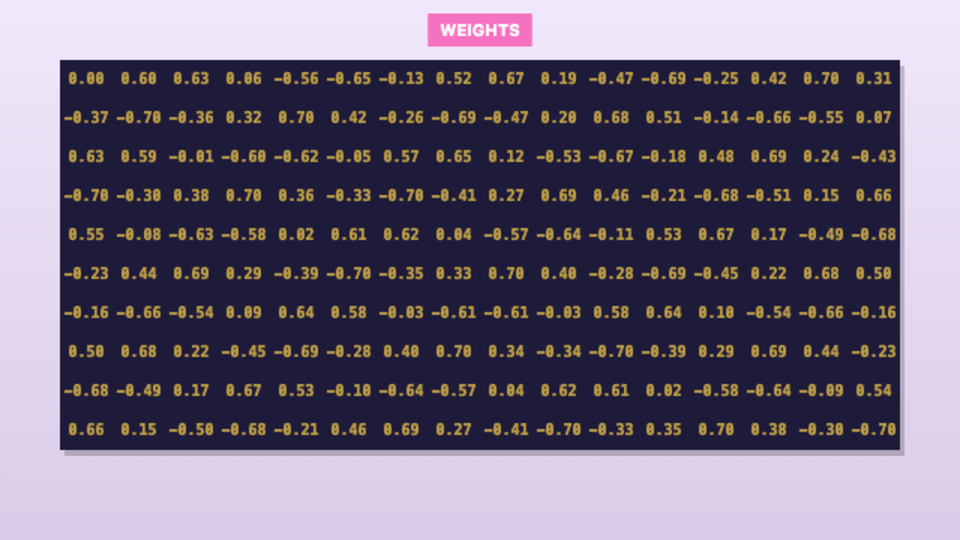
There's no tiny brain in there, no little person reading your message. Look — [pause:400] it's just numbers. A whole grid of them, going on forever. That's it. That's the whole thing.
These numbers have a name — weights. And a trained AI is really just one giant pile of them. How giant? ChatGPT has hundreds of billions. With a B. Way more than you could count in a lifetime.
And watch this — every single thing the AI seems to know is hidden in here. Every fact, every joke, every pattern in language. It's not stored in a library somewhere. It's baked right into these numbers. That's the whole knowledge.
But how did those numbers get the right values? That's training. Remember the guess, check, and adjust loop? Imagine that running over millions of examples, on rooms full of computers. We're talking weeks. Sometimes months of nonstop chugging.
Okay, so once training's done, we save all those weights. And we bundle them up with the math pipeline that knows how to use them. That whole package has a name you've heard a million times. A model. That's literally what it is.
Now, when you actually USE the model — your question goes in, an answer comes out — that part has a name too. Inference. And here's the thing: the weights don't change anymore. They're frozen solid. Your new question just flows through them.
So look — two completely different phases. On the left, training. Done once, takes forever, the weights are changing the whole time. On the right, inference. Happens every time anyone asks anything. Lightning fast, weights don't budge.
Your turn — try flipping back and forth. Notice how training is this whole giant operation, and inference is just one little phone getting an answer. Same model, totally different scale.
Here's a way to remember it. An AI basically has two lives. First, a long slow one where it learns its weights. And then forever after, a super fast one where it just uses them. Learn once, use a billion times.
Try this — drag the slider slowly. You're watching one single inference happen. The signal goes in on the left and ripples through layer by layer until an answer pops out on the right. In real life? This whole thing finishes in milliseconds.
Quick recap of the big stuff. Weights are where the AI's knowledge lives. A model is the weights plus the math that uses them. Training fills the weights in — slow, just once. Inference runs your input through them — fast, every single time.
So now you actually know how an AI works under the hood. Pretty cool, right? But there's one big question we haven't touched. When the AI gives you an answer — is it actually correct? That's where we're going next.
Topics
Ready to try it yourself?
Where Knowledge Lives is a hands-on interactive video — watch it, then play with the idea live in your browser. Free, no sign-up.
Open in Kekula →