Voyager: The Cosmic Slingshot
Two tiny 1970s probes flew past the giant planets and stole a kick from each one's gravity — flinging themselves to the edge of the solar system and coasting for fifty years on almost no fuel, which is used only to keep their antennas aimed at Earth.
What you'll learn
- Voyager
- Gravity Assist
- Slingshot
- Newton's 1st Law
- Attitude Control
- Interstellar
In this video
Meet Voyager. Two identical probes, each no bigger than a small car, launched way back in nineteen seventy-seven. Today they are the two most distant machines humanity has ever built, tens of billions of kilometres away, out beyond every planet. And here's the amazing part: they got all the way out there on almost no fuel at all.
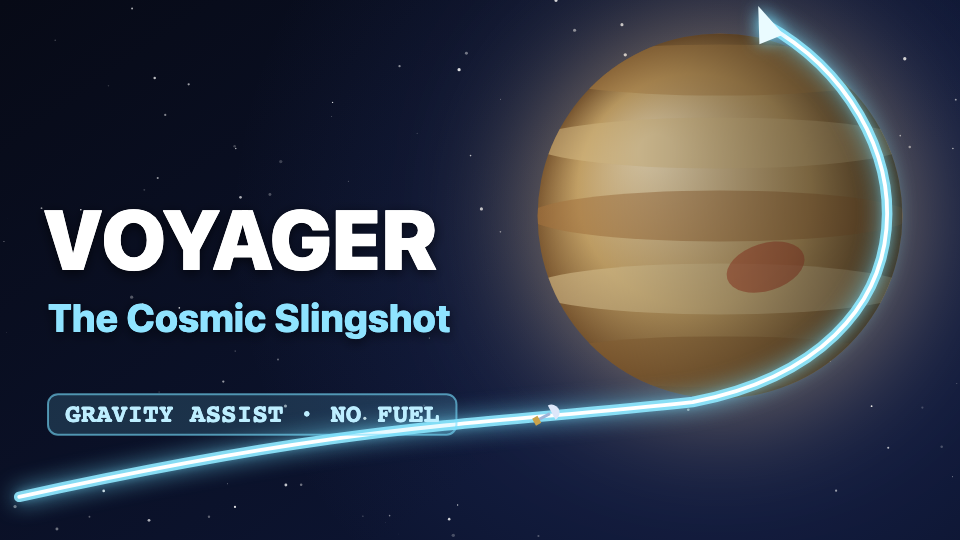
How do you cross billions of kilometres without a giant fuel tank? You steal a kick from the planets — a gravity assist. As the probe falls toward a giant planet like Jupiter, gravity whips it around and slings it back out — bending its path and speeding it up. But why doesn't it crash? It's moving too fast, and aimed a little to the side. Gravity can only bend its path, not capture it — so it curves past and escapes, faster than it came. The giant barely notices. The tiny probe just got a huge, free kick of speed.
And you can do it again, and again. In the nineteen seventies the four giant planets lined up in a way that happens only once every hundred and seventy-six years. So Voyager 2 flew a Grand Tour — slingshotting off Jupiter to reach Saturn, off Saturn to reach Uranus, off Uranus to reach Neptune. Each planet flung it onward to the next, like a ball in a cosmic pinball machine.
Here on Earth, everything that moves slows down — friction and air drag steal its motion. But space is empty. No air, no friction, nothing to rub against. So Newton's first law takes over: an object in motion stays in motion. Voyager hasn't fired an engine to speed up in decades. It doesn't need to. It simply coasts, at about seventeen kilometres every second, and it will keep gliding like that for millions of years.
So what is the tiny bit of fuel actually for? Not for going. For turning. Voyager carries small thrusters that give the gentlest little puffs — just enough to slowly rotate the spacecraft and hold it steady. And there's one thing it must always aim at: Earth. That big dish is its antenna, and it has to point almost exactly back at us, so its faint whisper of a signal can reach home. The fuel doesn't move it through space. It just keeps it facing us.
And so they sail on. Fifty years after launch, both Voyagers are still out there in the dark between the stars, still coasting, still whispering back the faintest signal — now taking almost a full day just to reach us. Each one carries a golden record: music, greetings, and sounds of Earth, in case anyone, someday, finds it. Two little machines, thrown outward by the planets themselves — humanity's farthest travellers, and they're still going.
Topics
Ready to try it yourself?
Voyager: The Cosmic Slingshot is a hands-on interactive video — watch it, then play with the idea live in your browser. Free, no sign-up.
Open in Kekula →