Earth & Space
36 interactive videos. Watch each one, then try the idea live. Free, no account.

How Clouds Form
Warm wet air goes up, cools, and water condenses into trillions of tiny droplets. That's a cloud.

Why It Rains
Droplets bump into each other, get heavy, fall. Cold version = snow. Cycled cold = hail.

Lightning & Thunder
Same physics as a doorknob zap — the size of a mountain. Count the seconds for distance.

Why We Have Seasons
It's not the distance. It's the 23.5° tilt of Earth's axis pointing toward Polaris.

Tour of the Planets
8 worlds, 2 flavors. 4 rocky + 4 gas giants. Mercury to Neptune.

Journey Through the Solar System
Strap in and fly through the whole solar system — a first-person flight from the Sun out past Neptune, skimming orbits, the asteroid belt, Jupiter's moons and Saturn's rings.
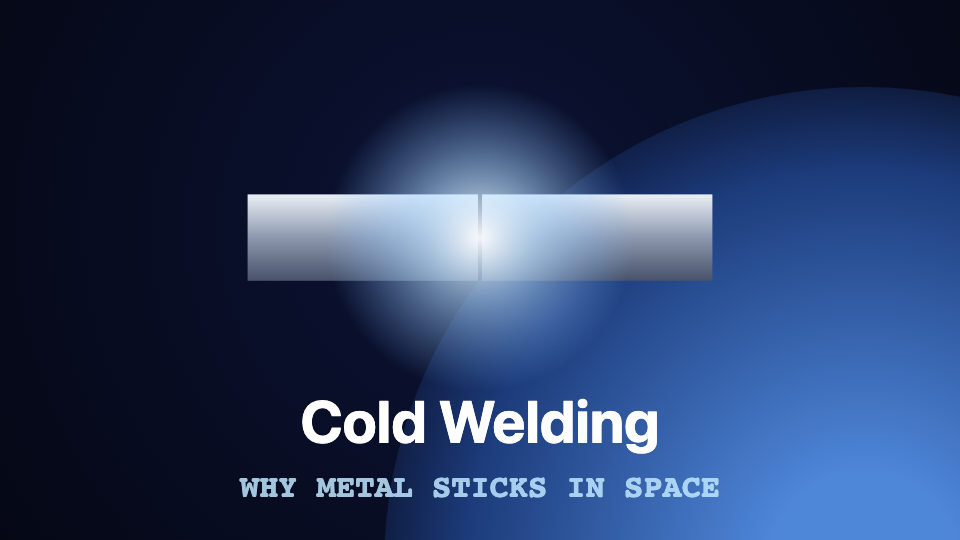
Why Metal Welds Itself in Space
Touch two clean metal blocks together in the vacuum of space and they fuse into one — no heat, no glue. Zoom to the atoms to meet the electron sea, the invisible oxide skin that stops it on Earth, and the day it nearly crippled a Jupiter probe.

How Many Satellites Orbit Earth?
See every satellite at once — the busy low-orbit swarm and Starlink trains, the Space Station, polar scanners, the GPS ring, and the geostationary satellites that hover over one spot forever.
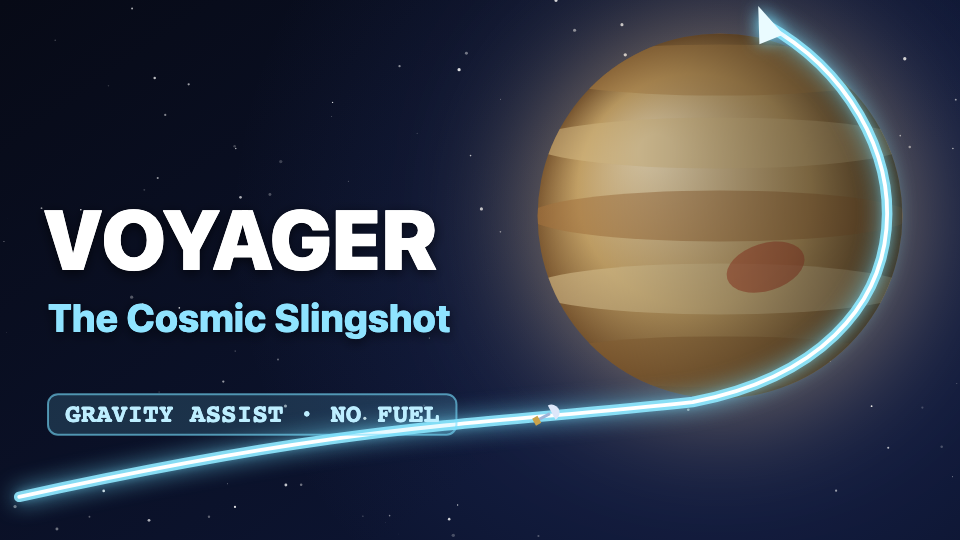
Voyager: The Cosmic Slingshot
Two tiny 1970s probes flew past the giant planets and stole a kick from each one's gravity — flinging themselves to the edge of the solar system and coasting for fifty years on almost no fuel, which is used only to keep their antennas aimed at Earth.
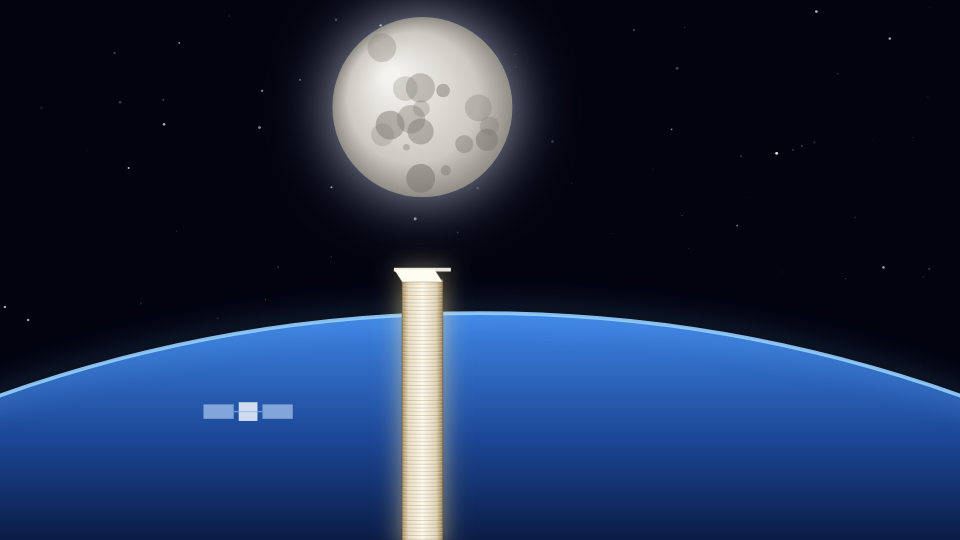
Fold Paper to the Moon
A sheet of paper is a tenth of a millimetre thick — but every fold doubles it. Watch a folded-paper tower rocket past you, a house, the Burj Khalifa and the edge of space, until 42 folds reach the Moon. That's exponential growth.

Jupiter: King of the Planets
Meet the giant of the solar system — the Great Red Spot storm bigger than Earth, a world almost made into a star, and four moons including Europa, with a hidden ocean that might hold life.

Saturn: The Ringed Giant
Get up close to the most beautiful world in the solar system — rings made of a billion chunks of ice, a six-sided storm at the pole, moons with seas of methane, and the only planet light enough to float in water.

Why the Moon Changes Shape
Spoiler: it doesn't. The moon is always a sphere — we just see different fractions of its lit half.

Why Eclipses Happen
Every solid thing in space has a shadow. An eclipse is one body inside another's shadow — and the Moon's tilted orbit is why it's rare.

Our Sun Is a Star
A medium-sized star you can see in the daytime — because it's right next door.

Why Volcanoes Erupt
Magma rises, pressure builds, rock can't hold it — and Earth's pressure-release valve pops.

Why Earthquakes Shake
Tectonic plates stick under stress, then slip suddenly. Seismic waves do the rest.

Why Canyons Cut So Deep
A small river over millions of years removes a mountain of rock. The Grand Canyon = the Colorado doing its job for ~6 My.

Rivers Inside the Ocean
Wind drives the surface. Density drives the deep. Together they pump heat around the planet.

How Rockets Fly
Newton's 3rd law made of fire. Throw mass down → get pushed up. Works in space too.

Comets & Asteroids
Two flavors of leftover solar-system stuff. One rocky and dull, one icy with glowing tails.

Every Star Is a Sun
Every twinkle is another sun. They look tiny only because they're trillions of km away.

What Is a Galaxy?
200 billion stars held together by gravity. We live inside one. There are 2 trillion more.

Galaxies Explained (v2 cinematic)
Real 3D galaxies. Spiral, elliptical, irregular — plus the Milky Way × Andromeda merger.

How Big Is the Universe?
Zoom from your room to the edge of what we can see. 30 powers of ten away.

How Astronauts Eat
In space, food floats away, crumbs clog vents. Eating had to be redesigned from scratch.

Mars Rovers
Alone on Mars, a robot drives itself, zaps rocks with a laser, runs on nuclear power for years — and one even made oxygen from the air.

The ISS Up Close
400 km up, 28,000 km/h. A laboratory in the sky, always there, always falling.

How Mountains Form
Two plates of Earth collide — and over millions of years, the crumpled rock piles up into a Himalaya.

How Rivers Flow
Gravity pulls water downhill. The channel widens. The river meanders. And the mouth fans into a delta.

Why Beaches Exist
Sand isn't placed there — it's MADE there. Waves grind rock for thousands of years.

V-Shape vs U-Shape Valleys
A river cuts a sharp V into the land. A glacier carves a wide U. Same valley name, different sculptor.

Where Rivers Meet Oceans
A river slows when it hits the sea, drops its mud, and builds new land — a delta.

Why Deserts Exist
Two recipes: a mountain blocks the rain, or hot air sinks at 30° latitude. Either way, no rain = desert.

Glaciers Shape the Land
A river of ice carves U-valleys, drops boulders, and scratches bedrock with hidden tools.

How Caves Form
Slightly acidic rainwater dissolves limestone over thousands of years, then drips back to form stone icicles.