Minus × Minus = Plus?
You memorized the rule. Nobody showed you why it works. Two flips on a number line — that's the whole secret.
What you'll learn
- Negative Numbers
- Sign Rules
- Number Line
- Multiplication
In this video
Negative three times negative four. Your teacher says the answer is positive twelve, and when you ask why, you get 'that's just the rule.' Not good enough. Think about it — multiplying by a negative already feels like losing. So losing... a loss... makes a gain? That sounds like a scam. But here's the thing: this rule isn't a decree from the math police. It falls straight out of a picture — one arrow on a number line, doing something you can actually watch. Once you've seen it, you'll never need to memorize the rule again. Let's build the picture.
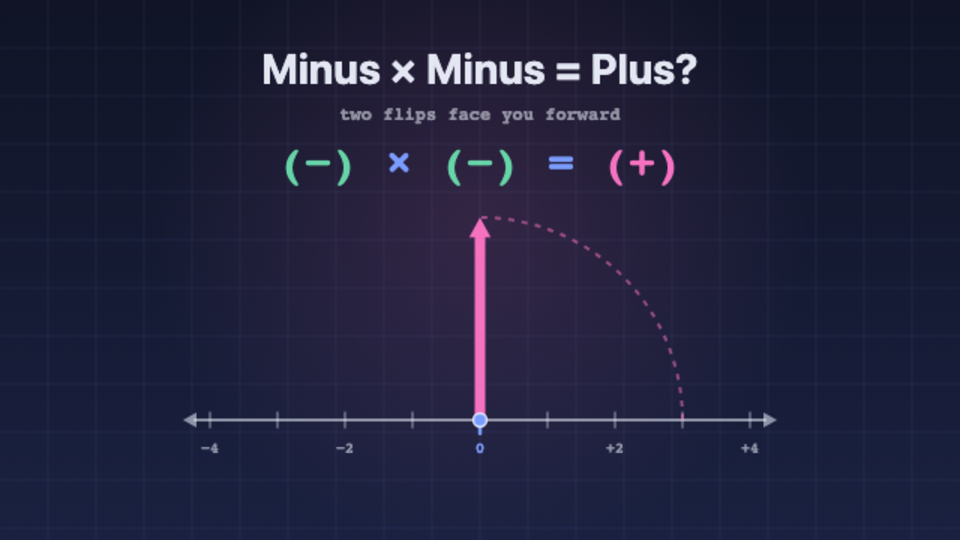
Here's the whole secret. Multiplying by negative one doesn't shrink a number or grow it — it flips it. A one-hundred-eighty-degree spin around zero. Watch the arrow: it points at positive three. Multiply by negative one, and it swings all the way around to negative three. Same length, opposite direction. Now multiply by negative one again. The arrow swings another one-eighty — and it's facing forward again, back at positive three. Two flips is a full turn. Face backward, then turn around again... you're facing forward. That's it. That's the entire mystery. Negative times negative is just flip, flip — forward. Now let's use it on real numbers.
Time to cash in the picture. Negative three times negative four. Split each negative into negative one times the plain number. So you've really got three times four — that's twelve — and two multiplications by negative one. Two flips. Watch twelve take them: first flip, the arrow spins to negative twelve. Second flip, it spins right back. Positive twelve. The size comes from three times four; the sign comes from counting flips. Even number of negatives — you end up facing forward, positive. Odd number — you're stuck facing backward, negative. That's the rule, writing itself. But if you want the version that convinces even the biggest skeptic, there's a pattern coming up that leaves no escape.
Here's the argument that ends every argument. Three times negative two is negative six. Two times negative two, negative four. One times negative two, negative two. Zero times negative two, zero. Look at the answers: negative six, negative four, negative two, zero. Every step, the answer climbs by exactly plus two. Now the big one — negative one times negative two. Most people's gut screams negative two: two minuses, must be extra negative. Lock in your answer. The staircase doesn't lie. Zero plus two is positive two. The pattern forces it — any other answer would break math's own rhythm. Negative times negative has to be positive. Still feels abstract? Wait till you see where you already use this.
You already live this rule. The temperature is dropping three degrees every hour — that's negative three. Rewind the video two hours — negative two. Negative three times negative two: six degrees warmer back then. Positive six. Or money: you owe four friends five dollars each. Twenty in debt. Someone cancels all four debts — removing negatives — and you're twenty dollars better off. Even cameras do it: one lens flips the image upside down, a second flip turns it right-side up. Two inversions cancel. Dropping temperatures rewound, debts erased, images double-flipped — reversing a reversal always lands you forward. Once you count flips instead of memorizing signs, none of these stay a trick.
Your turn at the controls. There's a walker on a number line. You pick the speed — walking right is positive, walking left is negative. You pick the time — play means the clock runs forward, rewind means we scrub backward to where they were. Before you press run, predict: which side of zero does the walker end up on? Lock it in, then run it and watch. Try all four combos. Backward walker plus rewound clock is the famous one — walking backward, rewound, means earlier they were ahead. Speed times time equals position, signs and all. When every combo stops surprising you, you own this rule. One last card to seal it.
Here's the whole thing on one card. Multiplying by a negative is a one-eighty flip on the number line. One flip faces you backward — that's why positive times negative is negative. A second flip faces you forward again — that's why negative times negative is positive. Size and sign are separate jobs: multiply the plain numbers for the size, count the flips for the sign. Even flips, positive. Odd flips, negative. You never memorized anything today — you watched an arrow turn around twice. Next time someone says 'that's just the rule,' spin your finger in two half-circles and enjoy the look on their face.
Topics
Ready to try it yourself?
Minus × Minus = Plus? is a hands-on interactive video — watch it, then play with the idea live in your browser. Free, no sign-up.
Open in Kekula →