SOH CAH TOA: Triangle GPS
Same angle, same ratio — locked, no matter the size. That lock is sin, cos, tan. Measure a rooftop with one angle and a tape measure.
What you'll learn
- Trigonometry
- sin cos tan
- Similar Triangles
- Angles
In this video
Here's a challenge. There's a flagpole across the street, and I want to know exactly how tall it is. No ladder. No tape measure dangling from the top. No climbing. All I get is this: the distance to its base, and the angle I tilt my head back to see the top. That's it. Two numbers from the ground — and I can tell you the height to the centimetre. Surveyors do this. Pilots do this. Your phone's measuring app does this. The trick fits in nine letters, and it's hiding inside every right triangle. Let me show you the picture that unlocks it.
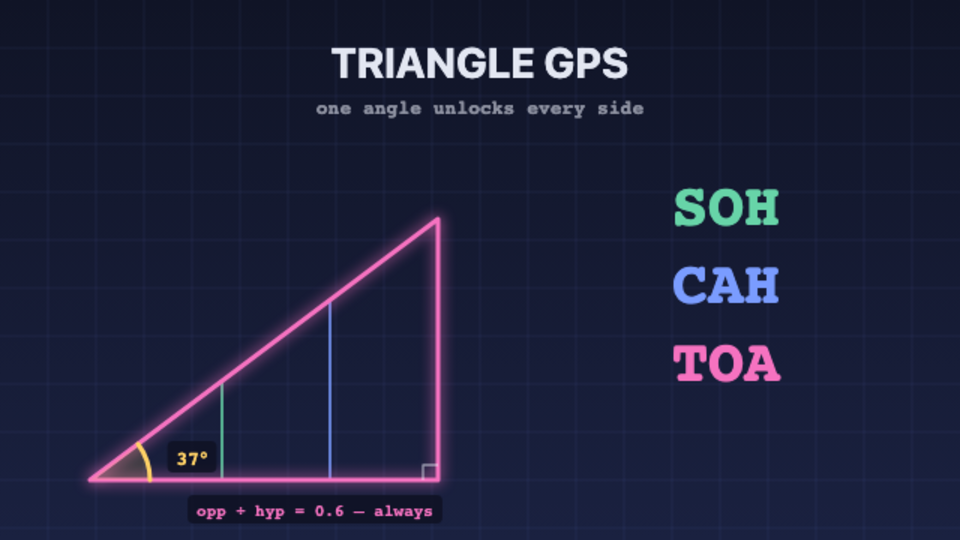
Watch this triangle. It has a right angle, and a thirty-seven degree angle in the corner. Now I'm going to grow it — same angles, bigger triangle. A scaled copy. The side across from the thirty-seven — the opposite — grows. The longest side — the hypotenuse — grows too. But divide one by the other and watch the number. Three divided by five: zero point six. Six divided by ten: zero point six. Nine divided by fifteen... Zero point six. Every time. Grow the triangle all you want; that ratio is locked to the angle. Locked numbers deserve names. Mathematicians called this one the sine of thirty-seven degrees. And there are two more.
First, names. The slanted side, opposite the right angle, is always the hypotenuse. The other two depend on which angle you're standing at: the side across from your angle is the opposite; the side touching it is the adjacent. Move to the other corner and watch the labels trade places. Now the rule: SOH CAH TOA. Sine is opposite over hypotenuse. Cosine, adjacent over hypotenuse. Tangent, opposite over adjacent. Let's use one. The flagpole: I stand twenty metres away and look up at thirty-five degrees. Opposite is the height. Adjacent is my twenty metres. That's tangent territory. Height equals twenty times tan of thirty-five — fourteen metres. But there's a trap coming.
A zipline drops from a forty-metre tower, and the cable meets the ground at thirty degrees. How long is the cable? The forty metres is across from the thirty-degree angle — opposite. The cable is the hypotenuse. Opposite and hypotenuse: that's sine. Sine of thirty is exactly a half, so forty divided by a half... lock in your answer. Eighty metres. Now the trap. Half the class labels that forty-metre side adjacent, because it touches the triangle — and cosine spits out forty-six metres. Order that cable and your ride stops thirty-four metres short. Adjacent means touching YOUR angle. Always ask: where am I standing? Because this one trick is holding up more than ziplines.
This is everywhere once you see it. Roofers describe steepness as rise over run — a six-in-twelve roof rises six for every twelve across. That's just tangent: zero point five, about twenty-seven degrees. Pilots ride a three-degree glide slope to the runway; ten kilometres out, tan of three degrees puts them five hundred and twenty-four metres up — every landing, every airport. And that measuring app on your phone? It reads the tilt angle, you give it the distance, and it does tangent for the height. Ramps, ski slopes, wheelchair access laws — one part rise to twelve parts run, four point eight degrees. Angles and ratios, everywhere. One angle and one distance, and the height falls right out.
Your turn to be the surveyor. There's a building across the street. Tilt your sight line with the angle slider until it locks onto the rooftop — you'll see it snap when you're on target. The screen shows your two knowns: the angle you're aiming at, and the ground distance to the base. Now the real test: before you press reveal, set your prediction. How tall is that building? Commit. Then press reveal and watch the triangle solve itself — tangent of your angle, times the distance, equals the height. Try a new building. Try a far one. When your guesses start landing within a metre, you're not guessing anymore — you're doing trig. Let's put the whole thing on one card.
Here's the whole of it on one card. Right triangles with the same angle are scaled copies of each other, so their side ratios never change — the ratio is locked to the angle. Sine, cosine and tangent aren't spells; they're the lookup table for those locked ratios. SOH: sine is opposite over hypotenuse. CAH: cosine, adjacent over hypotenuse. TOA: tangent, opposite over adjacent. Name the sides from the angle you're standing at, pick the ratio that uses what you know, and solve. One angle plus one side, and the whole triangle surrenders. Next time you pass a building, tilt your head back and smile — you can measure it from right where you stand.
Topics
Ready to try it yourself?
SOH CAH TOA: Triangle GPS is a hands-on interactive video — watch it, then play with the idea live in your browser. Free, no sign-up.
Open in Kekula →