Why x² Makes That Curve
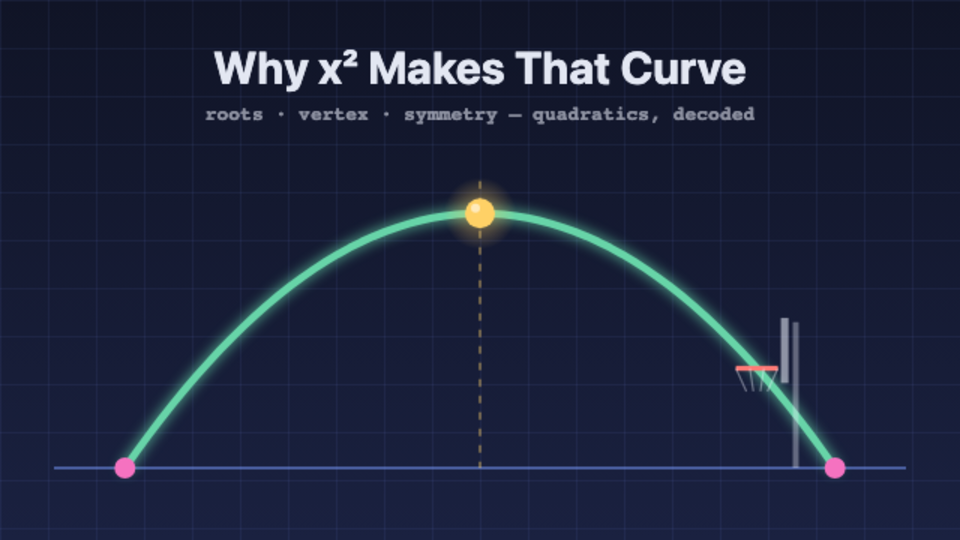
Every basketball shot flies the same curve. Squaring is fast and mirrored — and the parabola is inevitable. Roots are where it lands.
What you'll learn
- Quadratics
- Parabolas
- Factoring
- Roots & Vertex
In this video
Watch a basketball leave someone's hands. It rises, it slows, it turns, it falls — and the shape it draws in the air is always the same curve. Not sometimes. Always. Every free throw, every water fountain, every ball you've ever tossed across a room. That shape has a name: the parabola. And here's the part nobody tells you — it isn't a coincidence, and it isn't physics being mysterious. It comes straight out of one tiny piece of algebra you already know: squaring a number. x squared. That's the whole secret. Let me show you why squaring a number builds this exact curve, every single time.
Here's the picture. Take a number, square it. One squared is one. Two squared, four. Three squared, nine. The jumps get bigger every step — squaring grows fast. Now try the negative side. Negative three squared? Also nine. Negative two? Also four. The left side gives exactly the same answers as the right. So when you plot y equals x squared, the graph has to shoot upward fast in both directions — and it has to be a perfect mirror image around the middle. Fast growth plus perfect symmetry: that's all a parabola is. The shape isn't a design choice. It's inevitable. Next up: the three landmarks every parabola has.
Every parabola has three landmarks. The roots — where the curve touches height zero. On a thrown ball, that's literally where it lands. The vertex — the turning point at the top or bottom. And the axis of symmetry — the mirror line straight through the vertex. Now watch algebra find the roots. Take y equals x squared minus five x plus six. Factor it: x minus two, times x minus three. A product is zero only when a factor is zero — so x equals two, or x equals three. Look at the graph: the curve touches zero at exactly those two spots. Factoring isn't a worksheet trick. It's finding where the ball lands. Next: reading a whole flight path straight off the factors.
Round two — read this one with zero work. y equals negative one times x minus one, times x minus five. Roots: x equals one and x equals five, straight from the factors. The vertex sits exactly halfway between the roots — so where's the top of this arc? Lock in your answer. x equals three. Plug it in and the height is four. Now, two traps. One: factors only split apart when the product equals zero — if it equals eight, you cannot set x minus one to eight. Two: this curve is not half a circle. Watch the coral circle drift away from the real curve — a parabola's arms are straighter and go on forever. So where do these arcs show up in real life? Everywhere.
So where does this show up? Everywhere something flies, sprays, or shines. A basketball leaves your hand about two meters up and has to drop through a rim at three point zero five meters — players tune the arc, because a higher parabola falls through a wider target. Fountain jets are parabolas drawn in water; every droplet rides one. Headlights and satellite dishes are parabolas in metal — the curve bounces every ray through one focus point, so a tiny bulb becomes a straight beam. And every angry-birds-style trajectory in every game you've played is just y equals a, times x minus r-one, times x minus r-two. Set the roots, and the arc is already decided.
Here's your launcher. The ball will fly along y equals a, times x minus r-one, times x minus r-two. r-one is where it launches. r-two is where it would land. a controls how tall and tight the arc is. Your target: the hoop, hanging at height three, eight meters out. But no preview curves — you have to read the equation like a player. Will this shot clear or miss? Make your prediction first, lock it in, then hit fire and watch the parabola draw itself. If you miss, don't guess randomly — think about which knob to turn. Move the landing root past the hoop. Flatten or steepen a. Every adjustment is algebra you now own. When you've sunk a few, one last card locks it all in.
One card, whole idea. Squaring grows fast and treats left and right identically — so y equals x squared must curve upward in a perfect mirror shape. That's the parabola. Its roots are where it touches zero: the landing spots, and factoring finds them, because a product is only zero when a factor is. Its vertex is the turning point, always halfway between the roots. So when you see y equals a, times x minus two, times x minus eight — you already see the whole flight: lands at two and eight, turns at five, tall or flat depending on a. Next time a ball leaves your hands, watch the arc. You know its equation now.
Topics
Ready to try it yourself?
Why x² Makes That Curve is a hands-on interactive video — watch it, then play with the idea live in your browser. Free, no sign-up.
Open in Kekula →