Slope: The Steepness Number
A ramp, a staircase, and a graph walk into a math class — and one number describes all three. Meet m.
What you'll learn
- Slope
- Rise Over Run
- y = mx + b
- Linear Graphs
In this video
A wheelchair ramp outside your school. A staircase. A line on a graph in math class. Totally different things — except they're not. Every one of them is hiding the same secret: a single number that says exactly how steep it is. Not 'kind of steep'. Not 'pretty steep'. One number, and steepness is settled — for ramps, roofs, roads, rollercoasters, and yes, that y equals m x plus b thing your teacher keeps writing. Mathematicians call the number slope, and they write it as m. Here's the wild part: once you can see it, you can't unsee it. So let's see it.
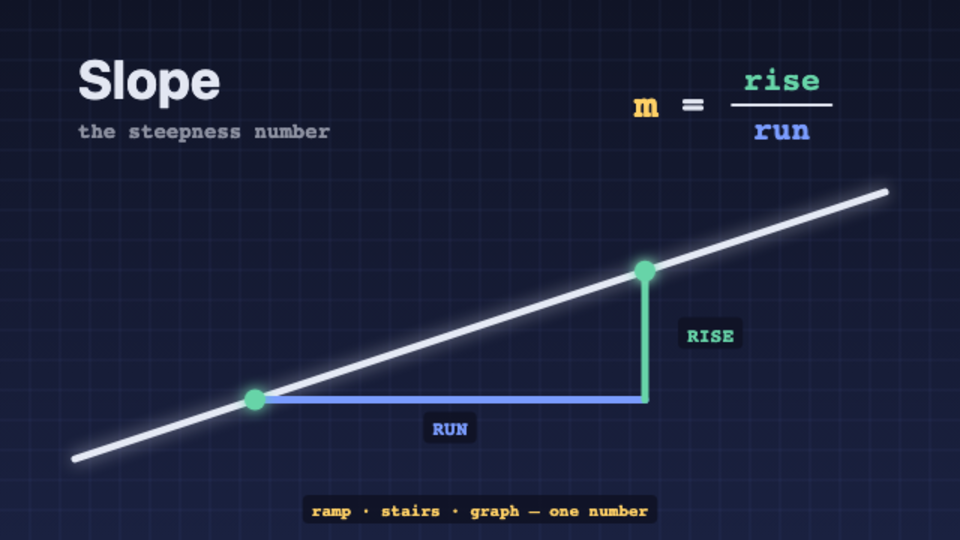
Here's the picture. To measure steepness, you ask one question: for every step I move across, how far do I climb? The across part is called the run. The climb is called the rise. Slope is just rise divided by run. Watch the ramp: run four meters across, rise two meters up. Two over four — that's a slope of zero point five. Now the staircase: same run, same rise. Same zero point five. The graph line? Identical. Three costumes, one number. That's the whole idea — steepness compressed into a single value: m. But can you actually calculate it from a graph? Two points is all you need.
Two points: two comma three, and six comma eleven. That's enough to nail the slope. Draw the run first: from x equals two to x equals six — that's six minus two, a run of four. Now the rise: from y equals three up to eleven — eleven minus three, a rise of eight. Slope is rise over run — eight over four. Lock in your answer. It's two. m equals two: this line climbs two units up for every single unit across. Any two points on a line give you the exact same m — that's what makes it a line. Next: what slope looks like on your phone bill.
Your phone plan: twenty dollars a month, plus five dollars per gigabyte. Graph it and you get y equals five x plus twenty. Suddenly the famous formula means something: b is twenty — where you start before using any data. m is five — the rate you climb per gigabyte. Now the trap. These two graphs show the exact same line — but the right one looks way steeper. Someone just stretched the axes. Your eyes are lying; steeper-looking is not bigger slope. Never judge m by look. Count the rise, count the run, do the division — the numbers can't be fooled. So where does this show up in real life? Everywhere.
Slope is everywhere adults just stopped noticing. That yellow road sign that says six percent grade? That's a slope: the road rises six meters for every hundred meters you drive — m equals zero point zero six, and truckers plan their brakes around it. Wheelchair ramps are law-grade slope: building codes demand one to twelve — one inch up per twelve inches across, about zero point zero eight — any steeper is dangerous. And your phone plan's five dollars per gigabyte? Every price-per-unit, every speed, every rate you'll ever meet is a slope wearing a disguise. Rollercoaster designers push m past three. Two numbers, m and b, and the whole line is decided.
Two knobs, one mission. The pink dots are your targets: two comma seven, and six comma thirteen. Your line has to pass through both. The m knob controls steepness — watch the line pivot around its starting point as you drag. The b knob slides the whole line up and down — it's where the line starts at x equals zero. Before you touch anything, predict: the dots climb six units over a run of four... what m is that? Now drag. Use the live rise-over-run rectangle to check yourself. When both dots sit on your line, you've found the equation. Nail it, then let's lock in the big picture.
Here's everything on one card. Steepness is a single number: m equals rise over run — how far up for every step across. A ramp, a staircase, a graph line: three costumes, same m. From two points, subtract to get the rise, subtract to get the run, divide — done. And y equals m x plus b is just a line introducing itself: b says where it starts, m says how fast it climbs. Next time you see a hill, a road sign, or a price per gigabyte, you'll see the number hiding inside it. That's the superpower: steepness isn't a feeling anymore. It's a number you can find.
Topics
Ready to try it yourself?
Slope: The Steepness Number is a hands-on interactive video — watch it, then play with the idea live in your browser. Free, no sign-up.
Open in Kekula →