Solve for x: The Balance Trick
An equation is a balanced scale. Tip it and the = breaks. Solving is just un-doing — watch x get peeled free.
What you'll learn
- Equations
- Solving for x
- Inverse Operations
- Balance
In this video
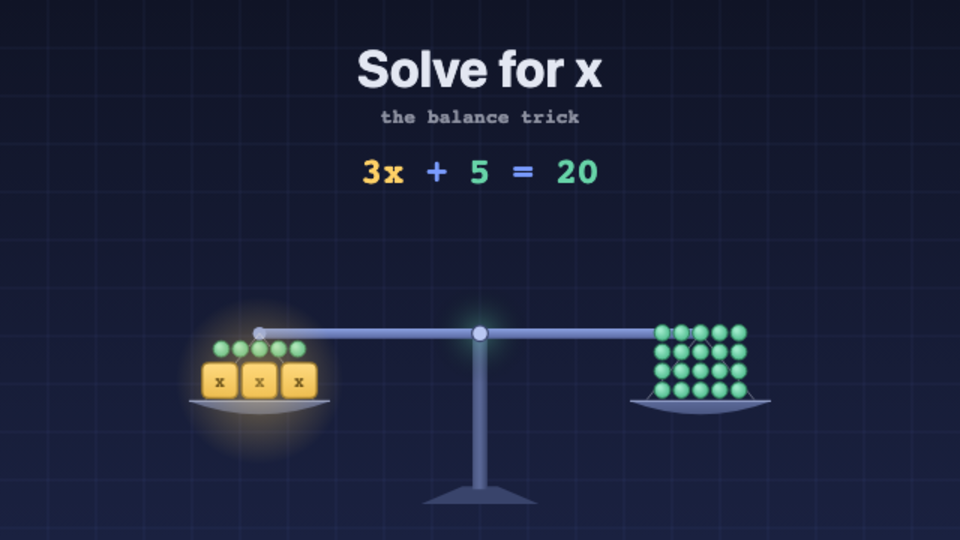
Three x plus five equals twenty. Solve for x. You've stared at a line like this and just... moved symbols around, hoping. Because nobody ever told you what an equation actually is. So here it is. An equation is a balance scale. The left pan holds three mystery boxes and five little weights. The right pan holds twenty. And that equals sign in the middle? It's not an instruction — it's a promise. Both pans weigh exactly the same. Right now, that promise is holding. Keep the promise while you clear the junk away, and the boxes will tell you what's inside them. Watch.
Look closer at the mapping. Every piece of the equation is sitting on this scale. Three x — that's three identical boxes on the left pan, each hiding the same number. Plus five — five one-gram weights next to them. Twenty — twenty weights on the right. And the equals sign is the pivot in the middle, the whole reason the beam sits level. That's the entire secret. Equals doesn't mean 'the answer is coming.' It means these two sides weigh the same, right now. Which gives you exactly one job: whatever you do from here, the beam must stay level. Break that, and everything you write afterward is fiction. So how do we get x alone without tipping it?
Here's the move, and it's the only rule in the game: whatever you do to one side, do to the other. Those five loose weights next to the boxes? Lift five off the left — and five off the right, at the same time. The beam doesn't even flinch. Three x equals fifteen. Now three identical boxes share fifteen grams, so split both pans into three equal groups and keep one group each. One box against... how much? Lock in your answer. Five. x equals five. Notice the order: we peeled off the plus five first, then undid the times three — undoing, in reverse. But everyone eventually gets lazy with the rule. Here's the mistake.
The classic: subtract five from the left... and forget the right. Watch the scale. It tips, hard. The moment those pans stopped matching, your equals sign became a lie — every line you write after this is confidently wrong. The fix is boring and beautiful: five off both sides, always. Now the boss level: four x minus two equals two x plus eight. Boxes on both pans. Same rule. Add two to both sides — four x equals two x plus ten. Take two boxes off both sides — two x equals ten. Split both in half. x equals five. X on both sides looks scary; it's just more things to peel off in pairs. So where does this show up outside a worksheet? Everywhere money is involved.
This is secretly how you already think. Splitting the bill: dinner was fifty-seven dollars, nine of that was the tip, three of you split the food. Three x plus nine equals fifty-seven — peel the nine, split by three — sixteen dollars each. Phone plan: thirty dollars flat plus six per gigabyte, and the bill says seventy-two. Six g plus thirty equals seventy-two — g is seven gigabytes. Gaming: you're at one-forty scoring thirty a round; your friend's at two-sixty scoring fifteen. One-forty plus thirty r equals two-sixty plus fifteen r... eight rounds and you've caught them. Every one of these is the same balanced scale. Keep the scale level, and x has nowhere left to hide.
Your turn on the scale. Take weights off a pan, take boxes off a pan — but here's the catch: the buttons work one side at a time. Take something off the left and don't match it on the right, and you'll feel it — the beam tips and the equals sign breaks. Undo is right there; no shame in it. Clear the loose weights in matched pairs, strip the extra boxes in matched pairs, and when one side is nothing but x-boxes, split both pans to finish. Before your last move, predict what's inside the box — then make the move and check yourself. Three equations, one rule. Keep it level.
One picture to keep forever. An equation is a balanced scale — the equals sign is a promise that both pans weigh the same. Solving is not sorcery; it's housekeeping. Whatever you do to one side, you do to the other, and you undo in reverse: peel away the plus five first, then split away the times three, until a single x-box sits alone facing its answer. That's it. That's the whole trick they never drew for you. Next time an equation stares you down — in homework, a bill, a game — don't shuffle symbols. See the scale. Keep it level, strip it down, and let x tell you what it's been hiding.
Topics
Ready to try it yourself?
Solve for x: The Balance Trick is a hands-on interactive video — watch it, then play with the idea live in your browser. Free, no sign-up.
Open in Kekula →