Percent, Decoded
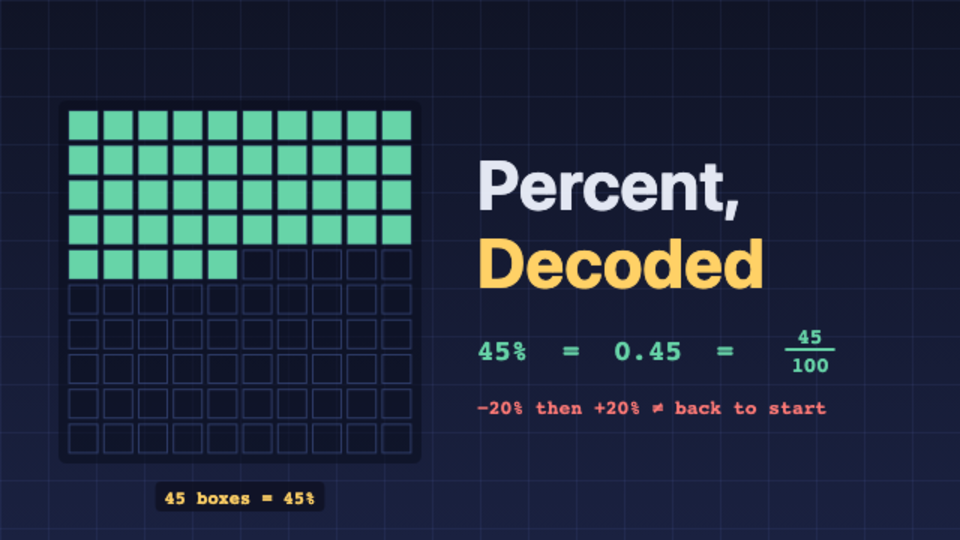
45% = 0.45 = 45/100 — one number, three costumes. And why −20% then +20% never gets you back where you started.
What you'll learn
- Percentages
- Fractions & Decimals
- Discounts
- Percent Change
In this video
Your phone hits forty-five percent and you start rationing screen time. Your test comes back ninety-two percent. The hoodie you've been watching is thirty percent off. Percent runs your entire life — and here's the awkward question: could you actually explain what one percent is? Not the vibe — the actual thing. Most people can't. And that's why percentages feel like sorcery: tips, taxes, discounts, interest, all guesswork. But percent has been hiding its own answer inside its name this whole time, and it's almost embarrassingly simple. One picture — a grid of one hundred little boxes — is about to make every percentage you will ever meet feel obvious. Here's the picture.
Percent is Latin wearing a disguise. Per centum — for every hundred. That is the entire secret. Take anything — money, battery, marks — and slice it into one hundred equal boxes. Each box is one percent of the whole thing. Watch the grid. One box shaded: one percent. Twenty-five boxes: twenty-five percent — that's a quarter. Fifty boxes: half of everything. Seventy-three boxes: seventy-three percent. Fill all one hundred and you own one hundred percent — the entire thing. So a percentage was never some mysterious symbol. It's a count of boxes out of a hundred. Nothing more. And once everything is boxes, shopping-mall math becomes almost unfairly easy. Let's go buy a hoodie.
First, the free gift. The same number owns three costumes: forty-five percent, the fraction forty-five over one hundred, and the decimal zero point four five. Switching costumes is just sliding the decimal point two places. That's the whole conversion. Now spend it. A sixty-dollar hoodie, twenty percent off. Put twenty percent in its decimal costume — zero point two zero — and multiply: zero point two times sixty is twelve dollars off. You pay forty-eight. But here's the pro move. Twenty percent off means you keep eighty percent. So skip the discount: zero point eight times sixty — forty-eight dollars in one step. Same answer, half the work. So can a percentage ever lie to you? Oh, it absolutely can.
Percent adds on the same way. Forty-five dollar pizza night, twenty percent tip: you're paying one hundred twenty percent, so one point two times forty-five — fifty-four dollars. Easy. Now the trap. That sixty-dollar hoodie drops twenty percent: forty-eight. Next week the store hikes prices twenty percent. Down twenty, up twenty — surely it's back to sixty. Lock in your answer. Fifty-seven dollars and sixty cents. Not sixty. The drop was twenty percent of sixty — twelve dollars. The hike was twenty percent of forty-eight — only nine sixty. A percent is always a slice of the current number, and the current number changed underneath you. Percentages don't undo. So where does this actually show up in your life? Everywhere.
Your phone says thirty-seven percent. That's thirty-seven boxes left of a four-thousand milliamp-hour battery — about fourteen hundred eighty left, and you instantly know whether that survives the bus ride. Your game says eighty-four hundred XP out of twelve thousand: seventy boxes shaded, seventy percent of the way to level thirteen. And the sneaky one — money. Park two hundred dollars in savings at five percent interest, and the bank adds five boxes: ten dollars, making two hundred ten. But next year's five percent gets measured on two hundred ten, not two hundred. The boxes themselves got bigger. That's compounding — the same trap from the hoodie, working for you this time. Same hundred boxes behind every one of them.
Your turn to run the store. Pick a starting price with the slider, then stack up to three percent changes on top of it — sale on a sale, or a sneaky markup after a discount. Before you press reveal, do the hard part: predict the final price and lock your guess in with the prediction slider. Then watch the grid settle it — every change cuts its boxes from the current price, never the original. Try minus twenty followed by minus twenty-five and check the total: it is not minus forty-five. If your guess lands within a dollar, you genuinely get percentages better than most adults at a checkout. Then we'll stamp the whole idea onto one card.
One card. Keep it forever. Percent means per hundred — slice the thing into one hundred boxes and count the shaded ones. Every number owns three costumes: forty-five percent, forty-five over one hundred, zero point four five — slide the decimal two places to switch. Twenty percent off? Multiply by zero point eight. Twenty percent tip? Multiply by one point two. And the rule that will genuinely save you money: every percent is a slice of the current number, so down twenty then up twenty never brings you home. Sixty, forty-eight, fifty-seven sixty. Next time a sale sign yells at you, you won't be guessing — you'll be the one seeing the boxes.
Topics
Ready to try it yourself?
Percent, Decoded is a hands-on interactive video — watch it, then play with the idea live in your browser. Free, no sign-up.
Open in Kekula →