The Pythagorean Theorem, Seen
a² + b² = c² is not about letters — it's about actual squares. Count the cells, watch them rearrange, and the rule becomes obvious.
What you'll learn
- Pythagorean Theorem
- Right Triangles
- Areas
- Square Roots
In this video
You've been told to memorize this: a squared plus b squared equals c squared. The Pythagorean theorem. You can probably chant it in your sleep. But here's a question — has anyone ever shown you what it actually looks like? Because it's not really a rule about triangles. It's a rule about squares. Real squares, drawn on the three sides of a right triangle. Two small ones, one big one — and a promise: the two small squares, together, take up exactly as much space as the big one. Every single time. Sounds impossible to guarantee? Let's count it.
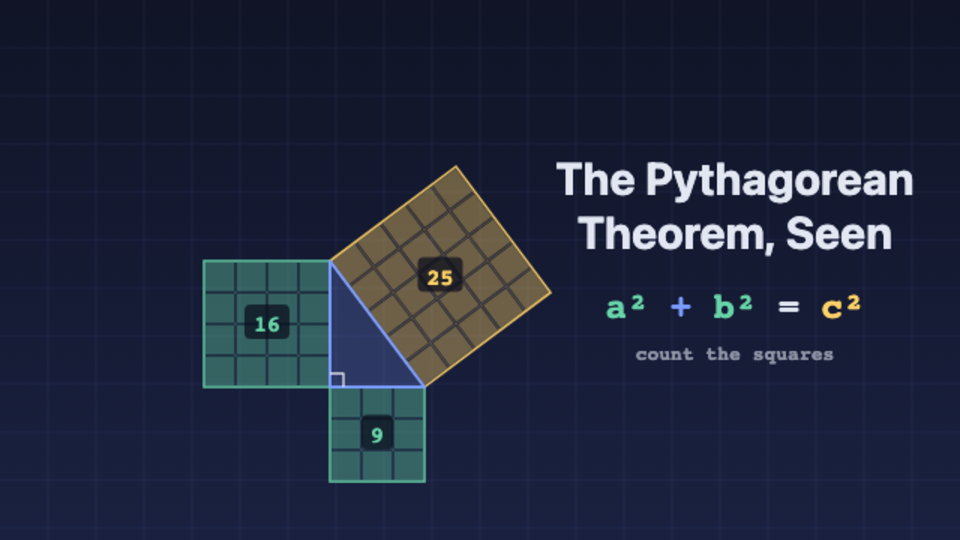
Here's the most famous right triangle in history: sides three, four, and five. Watch the squares. On the side of length three, a three-by-three square — count the cells as they fill. Nine. On the side of length four, a four-by-four square. Sixteen. Now the long side — the hypotenuse — gets a five-by-five square. Twenty-five cells. Time for the big claim. Nine plus sixteen is... twenty-five. Exactly. Not roughly — exactly. The two leg squares together hold precisely the same area as the hypotenuse square. That's all the theorem says: areas, matching perfectly. But one example isn't proof. Maybe three-four-five is a lucky fluke. So let me show you why it works for every right triangle ever.
Take any right triangle — legs a and b, hypotenuse c. Make four identical copies and park them inside a big square frame. Arranged this way, the empty space between them is one tilted square: c squared. Now watch the pieces glide. Same frame. Same four triangles. But now the empty space is two squares: a squared and b squared. Nothing appeared, nothing vanished — so the leftover area can't have changed. c squared equals a squared plus b squared. That's the whole proof, no algebra required. And it's instantly useful. Legs six and eight: thirty-six plus sixty-four is one hundred, and the square root of one hundred is ten. Hypotenuse: ten. Now let's flip the problem around.
Flip it. Now you already know the hypotenuse: c is thirteen, one leg is five, and you need the other leg. Lock in your answer. It's twelve. The move: thirteen squared is one-sixty-nine, five squared is twenty-five — and because thirteen is the hypotenuse, you subtract. One-sixty-nine minus twenty-five is one-forty-four. Square root: twelve. Now, the trap half the class falls into: adding plain sides. Legs six and eight, so c is six plus eight — fourteen? No. Square first, then add, then root — it's areas, not lengths. Second warning: no right angle, no theorem. On a slanted triangle the formula just lies to you. Rules understood. So where will you actually meet this thing?
Three places this theorem is hiding in plain sight. That fifty-five-inch TV? Fifty-five is the diagonal — the screen is only about forty-eight inches wide and twenty-seven tall, and forty-eight squared plus twenty-seven squared lands almost exactly on fifty-five squared. A rectangular field, one-twenty by ninety meters: walking two sides is two hundred ten meters, but the diagonal is one-fifty — cutting across saves you sixty meters of walking. And a ladder: thirteen feet long, base five feet from the wall — it reaches exactly twelve feet up. Same five-twelve-thirteen triangle you just solved, holding up a real human. Diagonals, shortcuts, ladders — it's everywhere there's a corner. Stretch the triangle however you like — those squares always balance.
Your turn to stretch a triangle. Drag the two handles to change the legs, and watch all three squares redraw with their areas counted live. Before you drag anything, predict: if you make both legs longer, what happens to the big square? Now test it. Then take the challenges at the top — build a triangle where the hypotenuse square is exactly one hundred, then one where it's one-sixty-nine. There's more than one way to hit some targets, and every shape you make keeps the promise: the two leg squares always add up to the hypotenuse square, exactly. When you've hit all three targets, come collect the whole idea in one picture.
Here's the whole theorem in one picture. A right triangle. Three real squares on its three sides. And one promise that never breaks: the two small areas together equal the big one — a squared plus b squared equals c squared. Remember it as areas, and everything else falls out for free. Need the long side? Square the legs, add, take the root. Need a leg? Square, subtract, root. Just check for the right angle first — that little corner square is the theorem's permission slip. Twenty-five hundred years old, and it still measures your TV, your shortcuts, and your ladders. Not bad for one little triangle.
Topics
Ready to try it yourself?
The Pythagorean Theorem, Seen is a hands-on interactive video — watch it, then play with the idea live in your browser. Free, no sign-up.
Open in Kekula →