What Is a Function?
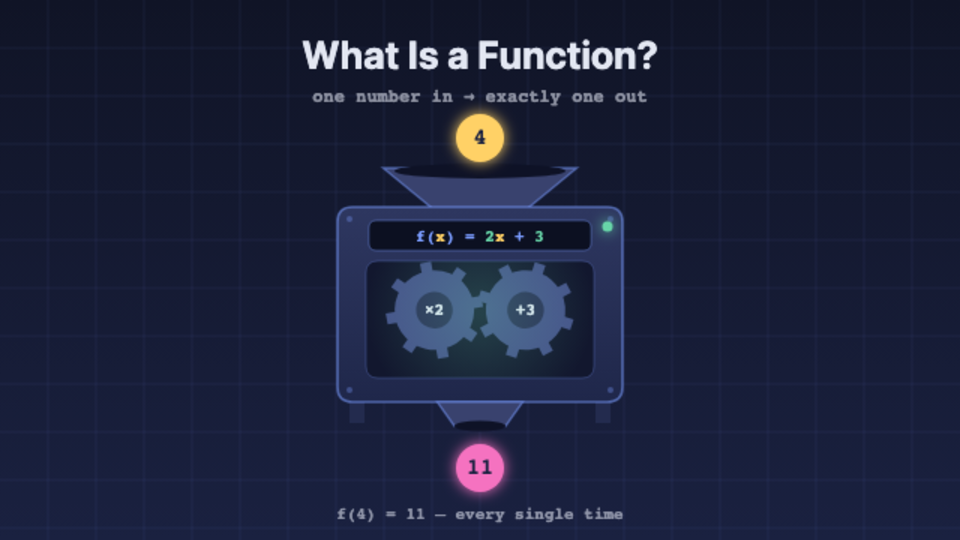
A function is a machine: feed it a number, exactly ONE answer drops out. Graphs are just its complete answer book.
What you'll learn
- Functions
- f(x)
- Graphs
- Vertical Line Test
In this video
f of x equals two x plus three. Your teacher writes it like it's the most obvious thing in the world. But be honest — what even is f? You've done math with numbers your whole life, and suddenly there's a letter wearing parentheses. Here's the secret nobody says out loud: f is not a number, and you never multiply by it. f is a machine. A little factory. Drop a number in the top, the gears turn, and exactly one number falls out of the bottom. That's the entire idea. Once you can see the machine, every scary function question turns into one friendly question: what comes out? Come meet it.
Meet the machine. The hopper on top is the input — that's x, any number you like. The label on the front, f of x equals two x plus three, isn't decoration. It's the job description: whatever falls in gets doubled, then three gets added. Watch the numbers ride through. One goes in, five comes out. Two in, seven out. Ten in, twenty-three out. And here's the one rule that makes this a function: every input gets exactly one output. Same number in, same number out, every single time. No moods, no surprises. One machine, four costumes — machine, table, arrows, graph — all the same idea. Now let's actually feed this thing.
f of four. That notation scares people, but it's just an order: feed the machine four. Before it travels, lock in your prediction — two times four, plus three. Got your number? Watch the trip. Four drops into the hopper. First gear: times two — four becomes eight. Second gear: plus three — eight becomes eleven. Clunk. Eleven slides down the chute. f of four equals eleven. If you said eleven, that's the whole skill — there is nothing more to it. f of ten? Twenty-three. f of zero? Three. One input, one journey, one answer. But writing out every trip is slow. What if one picture could show every answer the machine will ever give?
New machine: f of x equals x squared. Feed it the neighborhood around zero and log every trip in a table. Negative two gives four. Negative one gives one. Zero gives zero. One gives one. Two gives four. Now plot each row as a point and connect them — that curve is the machine's complete answer book: every x on it has exactly one y. Which sets up the classic trap. Is a circle a function? Slide a vertical line across it. At one input, the line catches two outputs. That's a vending machine handing you two different sodas for the same button — broken. One input, two answers: not a function. That's the vertical line test. So where do these machines show up in real life?
Everywhere you spend money, basically. At a fruit stand, price is a function of weight: mangoes at three dollars a kilo, so two kilos in, six dollars out. Same bag, same price, every time — that's what makes it fair. An Uber fare is a function of distance: two fifty base plus one seventy-five per mile, so an eight mile ride comes out to sixteen fifty. And your height is a function of your age — at every moment you've been alive, you had exactly one height. Now imagine any of these giving two answers. Two prices for one bag. Two fares for one ride. Chaos. Functions are just promises kept. And anything that breaks that promise is not a function at all.
Three mystery machines: A, B, and C. Their labels are hidden, and one of them is an impostor — not a function at all. Here's your interrogation technique: feed a machine the same input more than once and watch the output slot. A real function is boringly loyal — same in, same out, forever. The impostor will crack: feed it the same number twice and it hands you two different answers. That's the crime — one input, two outputs. Test all three, and when you're sure, make your accusation. The reveal shows every machine as a mapping diagram, and the broken one has a single input firing two arrows. Go catch it.
Here's the whole idea on one card. A function is a machine: a number goes in the hopper, exactly one number drops out of the chute. f of x equals two x plus three is the machine's label, and f of four just means feed it four — which gives eleven. The same machine wears four costumes: machine, table, mapping arrows, graph — and the graph is its complete answer book, every x with its one y. If any input ever gets two answers, the vertical line catches it, and it's not a function — it's a broken vending machine. One in, one out. That's the entire secret. Now go read graphs like answer books.
Topics
Ready to try it yourself?
What Is a Function? is a hands-on interactive video — watch it, then play with the idea live in your browser. Free, no sign-up.
Open in Kekula →